Blog

Interval ear training [Reference songs]

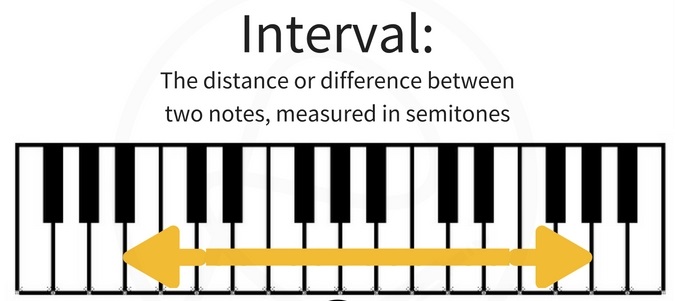
Using a reference song to recognise an interval is a very useful technique. Following is a list of all the intervals (ascending) with a corresponding reference song. The songs listed here are popular songs and therefore easy to remember.


Minor 2nd: Isn’t she lovely 

Major 2nd: Happy birthday 

Minor 3rd: Brahm’s lullaby 

Major 3rd: When the saints go marching in 

Perfect 4th: Here comes the bride

Tritone (minor 5th) : The devils note, and it doesn’t need a reference song! The tone is very evil and distinguishable.

Perfect 5th: Twinkle twinkle 

Minor 6th: Love story (theme song)

Major 6th: Jingle Bells

Minor 7th: The winner takes it all

Major 7th: Star wars (theme song)

Mixolydian mode

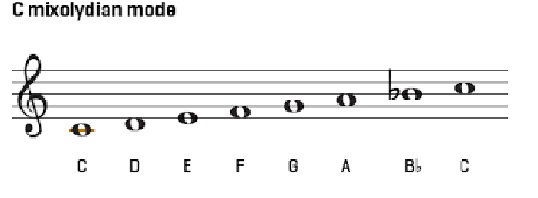
The third brightest of all modes is the Mixolydian mode. If you are not familiar with the ranking of modes from brightest to darkest, please read this before moving onto the Mixolydian mode. One very useful thing to remember is that we will study all modes based on the Ionian mode. The brightest of all modes Lydian not only has all the bright notes of Ionian but it has a raised fourth, which adds an extra layer of brightness to the overall tonality (read more about Lydian mode here). As we move from Lydian to Ionian, the tonality gets slightly darker and that comes from  flattening the fourth. So the idea here is that the more notes we will flatten, the darker it will sound. So on that same ground, moving from Ionian to Mixolydian, which is even darker, we can expect that a note is going to be flattened, and that for Mixolydian is the 7th note. So if key of C (Ionian) is C D E F G A B then key of Mixolydian is C D E F G A Bb.

The chords in C Mixolydian are the followings. Remember the number 357 as these are the chords that will be different from our chords in C Ionian.

C                                              C7

Dm                                        Dm7

Edim                                    Em7b5

F                                             FM7

Gm                                          Gm7

Am                                          Am7

Bb                                          BbM7

Along with the 3rd 5th and 7th chord, also notice that IM7 is actually a I7 chord in the key of C Mixolydian. All these 4 chords contain the flat 7th note which carry the Mixolydian tone so a chord progression with an emphasis on those chords will have a strong Mixolydian flavour.

The first part of Sweet Home Alabama by Lynyrd Skynyrd is written in D Mixolydian with an emphasis on the b7 chord.   Mixolydian is very popular in blues and also in rock and roll, AC/DC used Mixolydian extensively in their songwriting.

Setting up the online lesson

Please follow these instructions to setup the online session:


Option 1: (Skype)


Download Skype, either on phone or computer. Under ‘add new contact’, search for inquiry@maximsguitarworkshop.com and add MAXIMS GUITAR WORKSHOP.


Option 2: (Zoom)


Download Zoom . You don’t necessarily have to create an account unless you have one. Just let me know that you prefer Zoom so I can send you the link to attend the online session every time.


Option 3 : (FaceTime)


This would be the easiest. If you use any IOS device (ipad, iphone, macbook), we use FaceTime.
 

  1. Please make sure to go through the lesson materials before the online session.
  2. Use a bigger screen so it’s easier to watch the online instructions.
  3. Use headphones (preferable).
  4. Use two devices/monitors, in one keep the guitar tabs open and run the online session in another (preferable).
  5. Tune the guitar prior to the lesson.


Online lessons

Dear students, as you are all aware of the current situation due to COVID 19, I will be resuming online lessons from this week until everything gets settled. The lessons will be conducted over Skype (or Facetime). The lesson schedule, duration and structure will remain unchanged,  however, unlike our regular face to face lessons, I will upload the lesson materials a day before the online session. That way, you will get to go over the practice materials and will be easier for you to understand and for me to explain during the video session.

As they say, when life gives you lemons, make lemonade! The current situation is stressful, but as we are to maintain social distance and stay indoors, it is the best time to practice and take our guitar playing to the next level.

Being a musician myself, I can understand how badly the musicians got hit due to this pandemic, also how things will be difficult during the post COVID 19 recession. As a tight knit community here in Darwin, it is our responsibility to look after the professional musicians, whether they are performers, composers, session artists or music teachers. Hope we get to go through these difficult times quickly.

Lydian mode

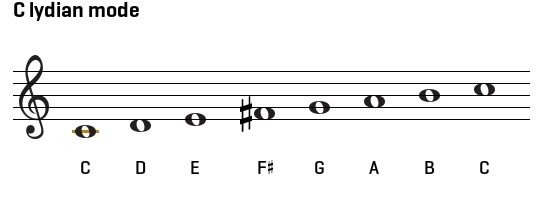
The brightest of all diatonic modes is the Lydian mode. Its best to learn Lydian mode as a modified Major scale which has a raised fourth. For example the key of C is C D E F G A B where as the C Lydian is C D E F# G A B. That raised fourth brings all that extra brightness and colour to a regular major scale so as songwriter, if you want that sound of hopefulness, focusing on that raised 4th note can get that job done. In terms of playing chords, the C Lydian chords are as following:

C                                            CM7

D*                                            D7*

Em                                         Em7

F#dim *                                F#min7b5*

G                                             GM7*

Am                                          Am7

Bm*                                        Bm7*

Compared to the regular diatonic chords in a major key, we have 3 noticeable difference. The 2 chord which is normally a minor turns to a major, the 4 chord which is a major is now a a raised diminished, and the 7 chord, which is supposed to be a diminished is now a minor chord. Remember the number 247 and that will allow you to figure out the differences between a regular major and Lydian.

The other noticeable thing here would be the GM7. It is supposed to be a v dominant 7th chord but here, the v chord is a major 7th.

The best way to use the Lydian key in songwriting would be to focus on these 3 chords (4 including the GM7) as all of these chords include the raised 4 note.

The theme song of The Simpsons is a classic example used in most music studies. I personally like the sound of II major chord in a major key and beautifully adds that extra hopefulness and positivity to the sound.

Difference between playing live and playing in front of the camera

I have been mostly making music at home since 2009. I was very active in the live music scene prior to that but since 2009, due to other commitments, I have focused more on music teaching and my own practice.  And occasionally I was performing at home, ‘in front of the camera’ as opposed to performing in live gigs. Few weeks ago I had to play with a band after almost 5 or 6 years and in this post I will share what it is like to play and perform in live gigs compared to playing alone and how to improve live performances. The differences are very distinct!

  1. Band chemistry: The most important thing for good live performance is the band chemistry which develops from years of practising and playing together. Some decent musicians who have been playing as a band for few years will beat a bunch of more skilled musicians who got together to play a gig any day. The first lesson I got from this experience is that band chemistry is everything. You will need to practice and perform, preferably with the same lineup and over time the overall band output becomes so much more quantized. Personal musical prowess can never trump the synergy a band can create.

  2. Performance anxiety: Performance anxiety is a thing and it affects every musician alike. Doesn’t matter how well prepared you are, some level of performance anxiety will always be there. I have realised that the popular narrative which is ‘the more prepared you are the less nervous you will be’ to be completely wrong. Good preparation will help you push through the nervousness and be able to put up a decent performance, but won’t let you be free of the nervousness. You will perform at a level below your best as nervousness will hinder your performance. The key here is not just practice but experience. You will need to go on stage and perform on a regular basis. Once this becomes a normal thing, the performance anxiety will diminish and you will be able to give your best.

  3. On-stage monitoring: Being able to hear what you are playing is far more important than what amp or what effects you are using. You will feel completely handicapped if you realise that the on-stage monitoring has been compromised and you can’t hear yourself properly. No matter how good your preparation is, this one issue can make everything messy. Often you will find things to be different during sound checks and during the real performance. What I realised is that in-ear monitoring is not just a luxury but a necessity for any kind of live gig. Being able to hear your own guitar and the rest of the instruments in a good mix can improve your playing 10-20%.

  4. Minimalism is the key: At the studio you may want to use tens of different amps, a very complicated signal chain but during a live gig, you want things to be as simple as possible. A simple signal chain, less number of guitar cables etc genuinely helps. I personally prefer using wireless system during live gigs. Nobody is there to notice the loss of signal (if any) through a wireless system compared to a cable during a live gig. It makes performance so much easier and  more lively!

The circle of fifths and its applications for a guitarist (part 1)


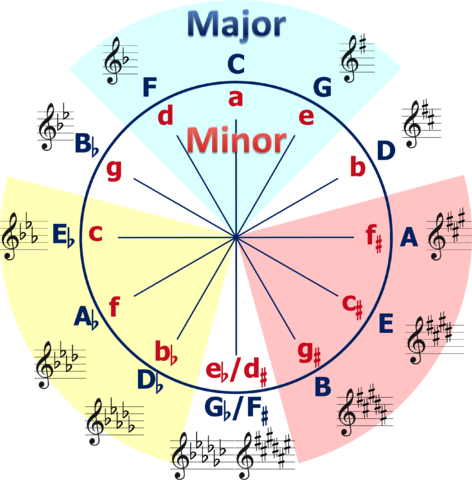
The circle of fifths was first invented by Nikolai Diletskii back in 1670. The root of the circle, divided into 12 segments comes from the ideas of Pythagoras (Pythagorean circle). The application of the circle of fifths is limitless and this post will cover only cover a handful of important contributions. In this part we will cover the notes on the outer circle (notes written in blue, which are the major keys).

  1. The circle of 5ths can be used to figure what notes are there in a key. Starting from 12 o’clock, the key of C has no sharp or flat. Moving clockwise to the next key, (1 o’clock) which is the key of G and has one sharp. This is a really easy way to remember how many sharps are there in a key. If the note is at 1 o’clock, it has one sharp. If it is at 2 o’clock, it has two sharps and so on. This applies to all the notes, all the way up to 6 o’clock which is F# and that has 6 sharps. The circle of fifths also tells you what note to sharpen. For example, to know what note is sharpened in the key of G, you only need to go two steps counter clockwise (11 o’clock) and that is an F note, and that is the note that is sharpened in the key of G. Same rule applies for D which is at 2 o’clock. So you know there are two sharps and they are F# (coming from the previous key) and C# (going two steps counter clockwise from D).

  2. The circle of 5ths also presents all the diatonic chords in a very efficient way. If you want to know the diatonic chords in a certain key, all you have to do is take the chords one step above and one step lower to that key. For example the diatonic chords in the key of C includes all the chords written at 11,12 and 1 0’clock (including the minors). Therefore the chords in key of C are C Dm Em F G and Am. You will notice that the diminished chord is omitted here.

  3. When you go counter clockwise from C, you get to find the keys with a different number of flats in it. For example, at 11 o’clock, the key of F has one flat. Moving one more step counter clockwise, the key of B flat (at 10 o’clock) has two flats and so on.

Apology note

Dear students, some of you might have noticed that over the last one month or so, there has been a delay in posting the lesson materials online and occasional lesson cancellations (from my end). I sincerely apologise for that and I believe you deserve an explanation. I have been struggling to keep up with the workload with too much on my plate. As you know that I lecture at CDU and during these last few weeks of the semester, there is just too much admin work (i.e. exam and assignment marking, setting questions etc.) on top of the lecturing. Plus I have my own research, guitar and band practise, preparing lesson contents and making videos. Plus uploading lesson contents under each student’s online profile takes roughly 10 minutes which also adds up.

Nonetheless, the semester is going to end in 3 weeks. And I have also stopped taking any new guitar student. This has predominantly grown through word of mouth (everyone wants to learn from the best :D, joking! or may be not 😉 ) But I have decided not to take any new student until I have more free time. Therefore, things will get back to normal after 3 weeks and the issues you are experiencing will all be resolved. I appreciate your understanding and patience. Keep practising and keep grinding. You all have been a source of my inspiration to be a better musician than I was yesterday. I hope I can inspire you the same way to stay disciplined and to work hard.

Realistic expectations when getting guitar lessons. How long does it take to learn to play at an elementary level?

Over the years working as a guitar teacher, I have come across many different types of students with different mindset and expectations. Some understand the process of learning and maintain a realistic expectation whereas some (including parents) would have very unrealistic assumption on the duration it takes to learn the instrument. Of course it is a life long pursuit but to learn how to play the guitar at an elementary level, where one can play the basic chords, play simple songs maintaining a decent groove, some basic improvisations, reading and aural capabilities which would be impressive to someone who doesn’t play an instrument varies on three things. Age, whether one played other musical instruments in the past and certain personal traits. How long one practices is a vital metric but let’s assume everyone is going to practice a minimum of 20 minutes everyday.

Age:

The earlier one starts (as early as 3-5) the better one gets and the better one understands music. That is true, however at an early age, improving the motor skills needed to play guitar is a little slow. Meaning a 5 year old is likely to learn slower than a 15 year old. But 5 years down the road, given they both practised with same intensity, the 5 year old will read and write better and also will have better aural skills. Because the 5 year old will learn music like a language opposed to someone who is older.

Past exposure to other musical instruments:

People who played other instruments in the past tend to find it a lot easier to learn the guitar. Predominantly it is due to the fact that one builds a good sense of rhythm and good ears playing other instruments and they can just bring that skill to guitar. Also it is easier for the brain to cope with the learning process as it did something similar in the past.

Personal traits:

Students who are good in academia, or in professional life tend to be also good at learning a musical instrument. Partly it is because the discipline. Someone with success in work, academia or sports tend to be disciplined with their work. They bring that mindset into learning guitar and it is the discipline that makes them better compared to someone who is lacking that.

These three things can immensely influence the duration it takes for one to learn. But by and large, it takes around one year to get to a point where one can play few tunes that would impress an average individual who doesn’t play guitar or other instruments.