
Songwriting hack
Need a support? 0432184511 inquiry@maximsguitarworkshop.com
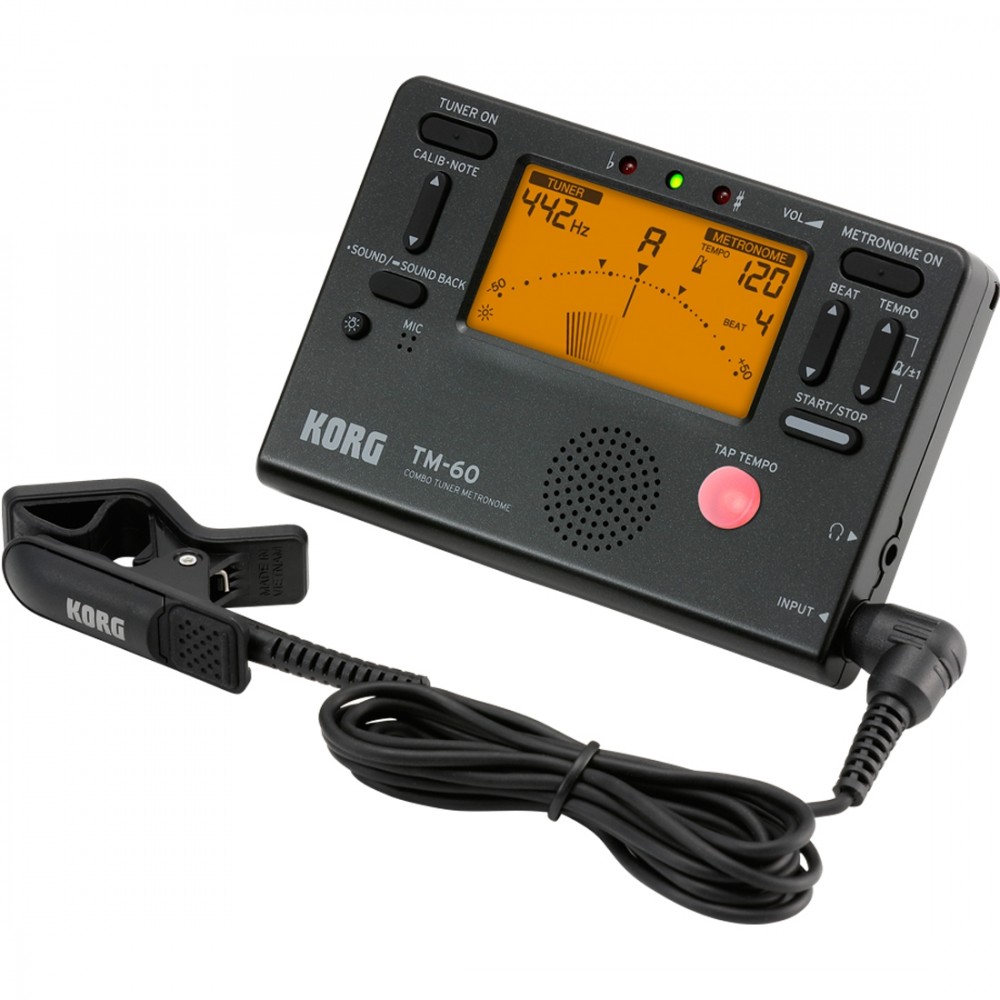
This probably goes completely against what you have read on forums or being taught by other guitar teachers. We have always been taught that practising with a metronome is the best way to practise and it helps to improve ones rhythm and sense of timing. But I beg to differ and always advice my students to practise without one, specially during the early days of learning guitar.
Instead of using a metronome, I recommend learning the art of tapping the foot while playing/practising the guitar. If tapping is not preferred, then bobbing the head or moving the body, something to embody the whole rhythm instead of using an external tool (i.e. metronome). Guitar players like Tommy Emmanuel and Paul Gilbert have always stressed on the importance of tapping in several of their interviews and/or guitar lessons. This is much harder than what it looks and a fairly difficult thing to master. But once it has been mastered, the timing of ones playing becomes so much tighter.
Metronomes are certainly useful when one is trying to improve the speed or breaking the plateau. But having a dependency on that is not the best way to become a better guitar player.

This is a controversial topic but in my experience I have noticed that playing in bands or being a performing artist can slowdown ones growth as a guitar player. I have come to this conclusion from my own experience and also observing several of my students who are regular performers. I was improving my guitar skills at a much slower speed when I was too busy performing compared to when I wasn’t. Same is true for the speed of improvement for my students who are performers vs who don’t.
This may sound quite paradoxical but the reasons are quite straightforward. When one is performing on a regular basis, a lot of the time and effort go into band practice, performance, travelling, sorting out logistics etc. One keeps playing the songs that are being performed for countless times and the growth from such repetition is diminishing and after a threshold, nothing new is learned or no skills get improved from playing those songs. Learning or composing new songs also fall within the comfort zone of the musician. One will use only the skills that are readily available to play the new song. If a new skill is required which is not known to the guitar player, he or she will either find an easier way to play that or completely avoid that. The reason is that acquiring a new skill requires not just a day or two of practice rather months, sometimes even years to get to a point to make it usable for recording. A performing musician doesn’t have the time or motivation to invest so much time to this and would rather perform or write songs as opposed to spending so much time learning something new or fixing a technical flaw of playing. The return from that is not immediate and we human beings are naturally driven by short term benefits over any long term ones.
I have noticed that with all my students who perform. They are just not interested (even if they say they are) to practice and fix any of the technical problems they have in their playing. Nor are they quick to learn new skills or new musical concepts as there is less time for that and more for playing/performing/writing songs. Same was true for me, when I was performing on a regular basis, I felt I was making big gains in my playing but on the hindsight, I know that I was not really making much of a progress and my playing was stuck at a certain level.
Of course few good things come from performance such as the ability to play with other musicians, stage smartness when performing live, the ability to interact with the audience etc and one can’t master these aspects by playing alone in his/her bedroom. The moral of all of this is that if you are not performing and genuinely working on your skills, technique and musical understanding, don’t think you are falling behind to someone who performs on a regular basis. You are actually making big gains if you do effective practice and working with an experienced mentor. If you are a performing artist, knowing these facts that performance can slowdown your growth as a musician, you can use this knowledge to ensure that despite all the business, you are dedicating some time everyday doing your own practice outside your involvement with the band. Practice that is solely dedicated to your playing and has nothing to do with the songs you perform. That way, you can enjoy the best of both worlds!
The short answer is ‘yes, you do’. The long answer is ‘it depends ………’
Private music lessons are usually expensive. But the expense is well justified because you get to learn from someone who is not only experienced in playing the instrument but also in teaching how to play it. With the money you pay, you get to buy the shortcuts that your mentor has learned from thousands of hours of practice. He or she knows what works and what doesn’t and therefore it saves hours of your practice time as you only get to learn what works as opposed to going through a trial and error process. Other than learning faster, learning under the guidance of a mentor means the chances are much higher that you will actually get to learn how to play the instrument and not quit after few months of trying. According to a study done by Fender guitars, around 90% of people quit playing guitar during their first year of learning. With an inspiring mentor, you are likely to be in the minority group of 10% and actually make it to the next level.
But if budget is an issue and private lessons are difficult to afford, it is better to learn through alternative means instead of going to an unqualified guitar teacher who is willing to give lessons for a very low tuition fee. There is a plethora of tutorial videos on YouTube, short courses on Udemy and Coursera that you can try to resume the learning journey. The other alternative is to get few tips from friends or family members who play the guitar.
So in a nutshell, if you can afford private lessons, go for it. You will get the worth of every penny spent on lessons and you will not regret it in the long run. Otherwise, use the alternative sources of learning. If you are sincere, you can certainly learn how to play just watching YouTube videos. But with the same level of dedication, you’ll go miles ahead working under the guidance of a mentor.
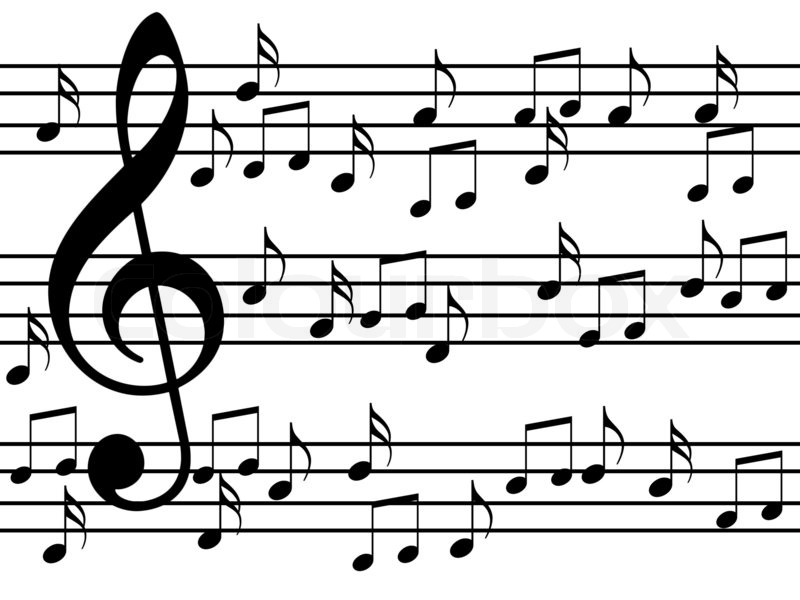
The arrangement of notes on The Staff depends on for what instrument the music has been written. In the context of guitar, we often use the Treble clef, which is also known as the G clef. Music written on G clef and Grand clef can also be played on guitar but not the most usual method of writing songs for guitar.
Treble clef looks like the following:

The notes on the treble lines are laid out as following:

A common mnemonics to remember the notes on Treble Lines is ‘Every Good Boy Does Fine’, and for the spaces just the word ‘FACE’.
We do not use bass clef or grand clef for guitar but on some music books, you may come across songs written using these clefs.
Bass clef looks like the following:

The notes on the bass lines are laid out as following:

Again, a common mnemonics for the bass lines is ‘Good Bikes Don’t Fall Apart’ and for the spaces ‘All Cows Eat Grass’
Finally, the grand clef, which is often used for instruments such as Piano, Organ etc. uses a combination of both treble and bass clefs together. To join these two, we need a C note in between which is often refereed to as the middle C. The grand clef looks like the following:

There are couple of other Clefs such as the Alto Clef (often used for viola) and the Tenor Clef (used for cello) but not relevant to guitar.

Beat, tempo, meter and pulse, four of the terms used almost interchangeably in music but are they the same? In some ways they do share similar characteristics but they do have distinct definitions and therefore should be looked at differently. Following are the definitions and then you decide how they are similar and what the differences are.
Beat:
Beat in simple terms in the unit we use to measure time in music. Think of this as second hand on a wall clock. A subdivision of the beat is also possible and that is called tuplet.
Meter:
Meter tells us how the beats are going to be grouped to form a bar. A 4/4 meter for example tells us that there will be four beats in each bar which we will count as 1 2 3 4. So each of those are single beats and they are grouped in 4. This grouping is defined by the meter.
Tempo:
Tempo tells us how fast the beats are going to be counted. Going back to the example of second hand on a clock, the second hand will move at a universal pace. But if there was a way to change that and fasten the clock, it would be the same as increasing the tempo of the song. Tempo in the context of music is measured in BPM (Beats Per Minute). If the tempo is 100 BPM, then the beats are spaced out in a way so that we can fit 100 beats in one minute. Meaning the higher the bpm, the faster the tempo or speed is going to be of that music.
Pulse:
Pulse defines how a person is going to feel the music. If a music is played, regardless of what the tempo or meter is, any layman would be able to feel the music and tap the foot along. How the music is felt and how the tapping takes place is called the pulse of the music. Often the pulse is not going to be exactly the same as the beats. For example, on a 6/8 meter, a person is likely to tap on the 1st and the 4th beat.
6/8 1 2 3 4 5 6

Tonal music is something that revolves around a certain tone or a key. Most of the Western music and music of popular genre are tonal music and very pleasing to our ears. All the discussions we have had about keys and modes basically revolve around a tonal centre which we also refer to as the home. It starts and ends on that tonal centre and therefore pleasing to our ears. Atonal music on the other hand is something that doesn’t follow any structure and doesn’t have any specific tonal centre. A good analogy for atonal music would be an abstract painting. How one is going to perceive an abstract paining is entire subjective and different people may give different meanings to it. Same is true for a piece of atonal music. Following is an example that demonstrates the characteristics of atonal music. It may sound completely absonant but if you listen to the music several times, it starts to make some musical sense.
Atonal music goes completely against the classical norm of music composition and a relatively new way of composing music. The idea originated in 1908. There are several 19th and 20th century composers (i.e. Alexander Scriabin, Béla Bartók etc.) who are known for their atonal compositions. Atonal music is also labelled as modern classical music by some people. So if you pick up the guitar and play some completely random notes, you may actually end up making some form of atonal music!
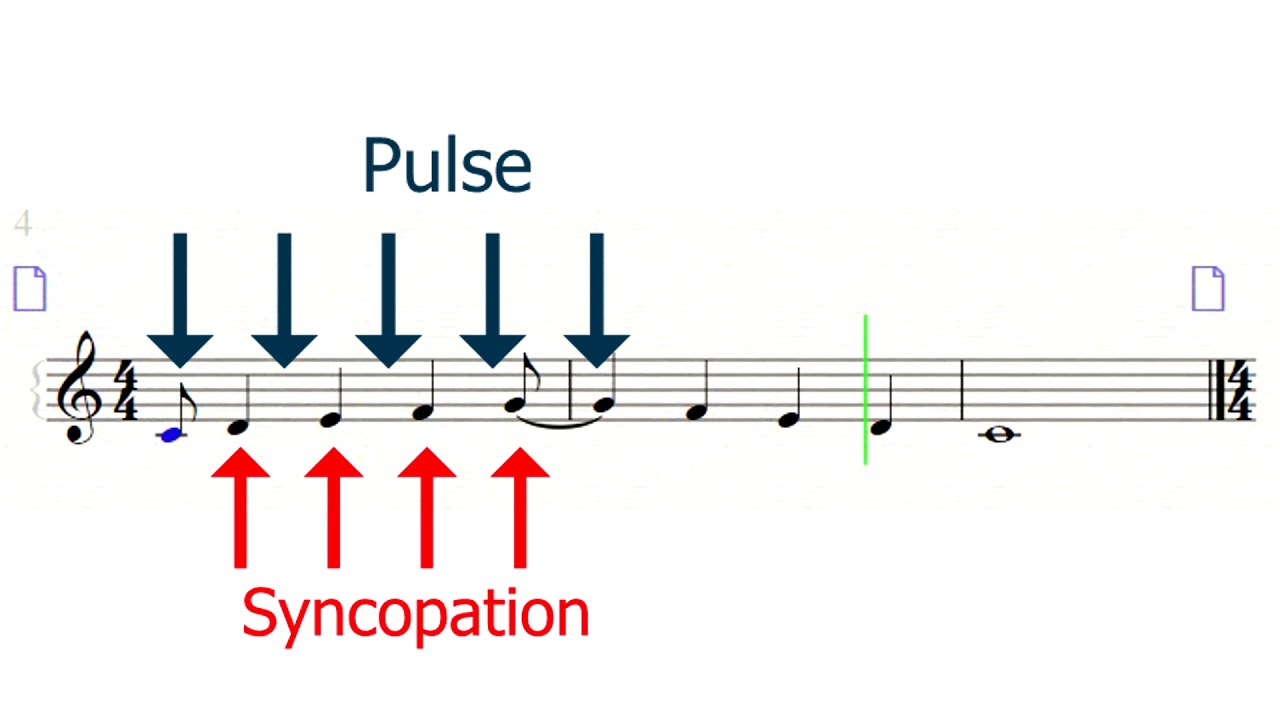
Syncopation is all about disturbing the natural flow of rhythm, something that our ears are very familiar with. When that flow is broken, that attracts a lot of attention of the listener because it’s unexpected. Using too much of syncopated rhythm can make a piece of music too obscure but the right amount can really spice up the music.
In all time signatures, there are strong and weak beats. in 4/4 the strong beats can be just 1, 1 and 3, or all the beats that is 1 2 3 4. Any one of these three combinations will sound very familiar to the ears. But altering these strong beats and putting the accent on weaker beats will result in a syncopated rhythm. Following are some examples commonly used in popular music.
Missed Beat
This is perhaps the simplest form of syncopation and involves replacing a strong beat in a measure with a rest. Below, the third beats of the 4/4 measures are missing. The pattern would need to be repeated over several measures in order to maximize the effectiveness of the syncopation.
Suspension
In this type of syncopation, notes tied over strong beats obscure the typical beat pattern. The example below shows a note tied over the bar line to displace the downbeat.
Offbeat
Offbeat syncopation occurs when notes change in the middle of the beat rather than on the beat. In the example below, if you count using the syllables “1-and-2-and-3-and-four-and,” you’ll notice that the “and” of the beats feel emphasized throughout most of the phrase, displacing the expected rhythmic pattern.

Accented
Syncopation can also be achieved simply by using accents. For example, the rhythm below, with unevenly accented eighth-notes, is common in Latin music.

Backbeat
In backbeat syncopation, beats two and four are emphasized, rather than beats one and two. This is the most familiar type of syncopation, found in the drum patterns of rock, pop, and more. If you turn on any song on the radio, chances are you’ll clap along with the backbeats. Backbeat rhythms were a novel concept heard in blues and early rock music—but these days, this type of syncopation is so common that it doesn’t sound unexpected to our ears anymore.
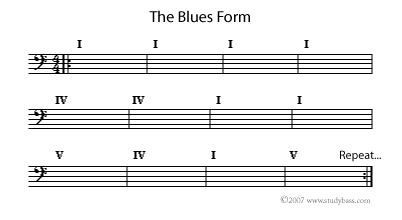
Blues is considered as the backbone of modern western contemporary music. Understanding blues requires understanding several aspects but the best place to start is to start with the 12 bar blues. As the name suggests, this is a structure comprising of 12 bars.
We will be using the blues progression here which is the I-IV-V-I of any key. A good key to learn the 12 bar blues for a guitar player is the key of E as this in standard tuning is reasonably easy to play and therefore easy to jam with other guitar players.
The structure of 12 bar blues goes as following (this example is in the key of E)
I I I I IV IV I I V VI I I
E E E E A A E E B A E E
There are lots of variations of the 12 bar blues but the one that we will be using is the one where the last section of the blues is used as a ‘turnaround’ where the last bar contains the dominant V instead of I chord. It goes like this.
I I I I IV IV I I (V VI I V) Turnaround
E E E E A A E E (B A E B) Turnaround
Now to add the blues tension to the sound of this progression, we need to play all the 7th chords instead of just the regular major chords. Lastly in the rhythm, we will have to add a swing or shuffle to give this a proper blues sound.